
The Short Answer
- The best ai sales tools divide into four distinct jobs: prospecting databases, outbound sending platforms, conversation intelligence recorders, and AI CRM or agent layers. Each captures different inputs and produces different model outputs.
- Apollo, Clay, and Cognism measure contact records and enrichment field results; the lead scores and intent layers they surface are model inferences, not verified buyer events, and require auditing before driving prioritization.
- Instantly and Smartlead measure per-mailbox delivery, open, and reply events; neither can confirm whether a message reached a primary inbox or a spam folder at the recipient’s provider.
- Gong records transcripts, talk time, and topic mentions as timestamped facts; deal risk scores and forecast confidence are model outputs built on historical call patterns, not auditable predictions with stated confidence intervals.
- HubSpot Sales Hub and Salesforce Agentforce automate actions inside your existing CRM data; both require clean, current records to produce reliable AI outputs and neither sources new contacts without a connected enrichment layer.
All prices below were checked on 2026-11-02 and change without notice; confirm each on the vendor’s current pricing page.
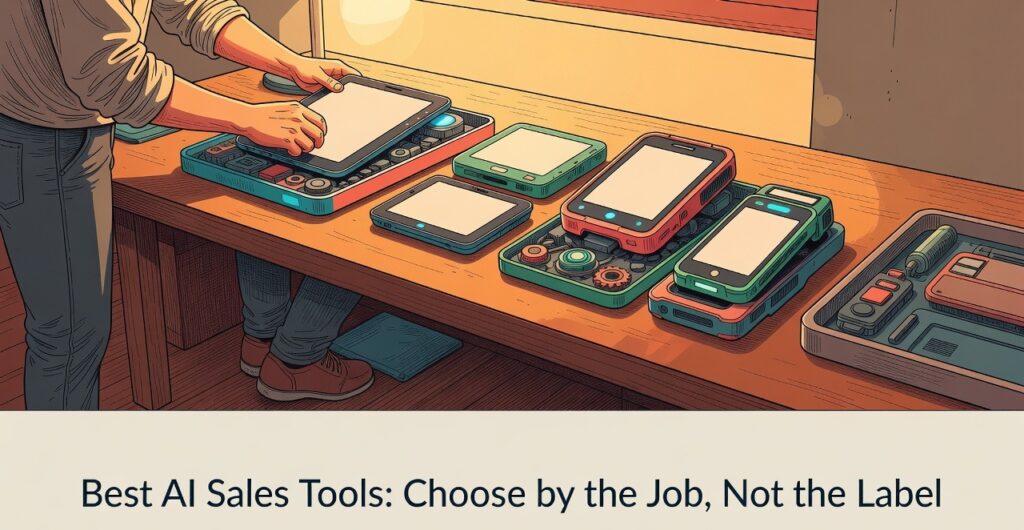
The best ai sales tools divide into four layers: a contact database to source and enrich prospects, a sending platform to execute and monitor email, a conversation recorder to log and analyze calls, and an AI CRM or agent layer to maintain the system of record. Most vendor comparisons rank tools by popularity or feature count rather than by the concrete job each one performs. This guide covers all four layers, labels every capability as MEASURES or INFERS, and names the point where each category stops working.
How to Evaluate the Best AI Sales Tools for Your Revenue Team
Evaluating AI sales tools starts with separating two things most vendors blend together: what the software directly records as a timestamped event, and what it calculates as a probability from selected signals. The first is evidence. The second is a hypothesis, and the difference determines whether a team can audit and improve an AI output or only accept it. An AI sales tool is any software that uses machine learning or large language models to automate a specific step in the sales workflow, from contact sourcing to deal forecasting.
In this guide, MEASURES applies to raw, observable inputs: a contact record created in a database, a delivery event logged by a mail server, a transcript of a recorded call, or a CRM field updated by a user or webhook. INFERS applies to model outputs such as a lead score, a buying intent signal, a deal risk rating, or a forecast confidence figure. These outputs are shaped by training data, feature weights, and signal recency, none of which vendors typically disclose without a direct ask.
In my experience, most of these tools combine multiple jobs in a single interface, which cuts integration overhead but makes it harder to identify which layer produced a specific output. A match rate with no denominator is not a number; it is a marketing claim. Before trusting any score, ask the vendor to name the underlying event, its timestamp, the model architecture, and the confidence range.
Prospecting and Enrichment: Apollo, Clay, and Cognism
Prospecting databases are the sourcing layer that builds and validates the contact list before outbound begins. Apollo, Clay, and Cognism each measure different inputs and cover different geographies; choosing between them depends on team size, geographic scope, and data compliance requirements. Apollo MEASURES contact records stored in its database, email open and reply events tracked through instrumented links, and sequence step completions logged in its engagement layer. Apollo INFERS lead scores from firmographic fit and behavioral proxies gathered across its user network; the score reflects a model judgment, not a verified indication that a prospect is evaluating your category. Coverage is strongest in North American technology and professional services sectors, with partial coverage in Western Europe. Pricing is listed on the vendor’s Apollo pricing page.
Clay operates differently from a traditional database. Clay MEASURES enrichment waterfall results at the field level: for each contact, it records which source returned a value and which returned an empty result. Clay INFERS fit scores only when a user builds a rule or an AI prompt to define what fit means for that workflow; there is no default autonomous model making judgments about contact quality. Geographic coverage depends entirely on the enrichment providers connected to the waterfall, so scope varies by configuration and provider selection. Pricing is published on Clay’s pricing page.
Cognism MEASURES verified phone numbers and email addresses, with compliance controls built for European and UK markets under GDPR. Cognism INFERS an intent layer sourced from Bombora’s behavioral data, which records topic-level research activity across publishing networks rather than confirmed purchase activity in your specific category. Coverage in the UK, Germany, and France makes it a practical choice for teams where European data compliance is a firm requirement. Cognism does not publish pricing and requires a quote. For teams running European pipelines, that GDPR posture is a concrete differentiator, not a marketing claim.
Outbound Sending and AI SDRs: Instantly and Smartlead
Outbound sending platforms execute email at volume and monitor delivery events per mailbox. Both Instantly and Smartlead measure delivery, open, reply, and bounce rates as server-side records. Neither can confirm inbox placement at the recipient’s provider. Before either platform is set up for production sending, every domain needs valid authentication records in DNS. Google’s sender guidelines require SPF or DKIM for all commercial senders and add a DMARC requirement for senders exceeding 5,000 messages per day to Gmail accounts.
Instantly MEASURES per-mailbox delivery events, open rates, click rates, reply rates, and bounce classifications per sending domain. It INFERS warmup reputation status from engagement pattern proxies across the mailbox pool. The DMARC standard defined in RFC 7489 specifies how domain owners publish a policy for unauthenticated mail; publishing that policy is a prerequisite for high-volume sending, not an optional configuration. The FTC’s CAN-SPAM compliance guide requires a valid physical address and a functioning unsubscribe mechanism on every commercial email, regardless of which platform delivers it.
Smartlead MEASURES similar per-mailbox metrics with multi-inbox rotation across Google Workspace and Outlook accounts, giving teams a wider mailbox pool for volume sending. It INFERS deliverability health from warmup engagement rates and bounce classifications, neither of which confirms inbox placement at the recipient side. The M3AAWG published best practices establish the industry-accepted baseline for responsible bulk sending. Both Instantly and Smartlead support global mailbox configurations.
Note: Warm-up scores and deliverability health metrics from sending platforms are inferences based on proxy engagement signals, not confirmed inbox placement data. Treat them as directional indicators and cross-check against independent spam placement tests before scaling volume.
Conversation Intelligence: What Gong and Fireflies Record
Gong and Fireflies record, transcribe, and analyze sales calls; both produce transcripts as measured facts and coaching or deal-risk outputs as model inferences. A transcript is a direct record of what was said. A coaching insight or deal risk score derived from it is a model judgment built on patterns across many calls, not a guarantee specific to any single deal. Human review is necessary before any deal progression decision relies solely on an AI-generated call output.
Gong MEASURES call transcripts, speaker talk time, question frequency, topic mentions by keyword category, and CRM field updates triggered by call events. Gong INFERS deal risk scores, forecast confidence levels, and next-step recommendations from patterns across the team’s historical calls and pipeline data. These model outputs carry no stated confidence intervals and are not auditable predictions. Gong does not publish pricing and directs teams to its Gong pricing page for a custom quote. Gong’s features are primarily optimized for English-language calls, with multilingual support in active development.
Fireflies MEASURES call transcripts, AI-generated meeting summaries, action items extracted from transcript content, and speaker-level sentiment classifications. It INFERS coaching insights and follow-up priorities from cross-transcript patterns. Fireflies publishes pricing on the vendor’s pricing page, so you can check the numbers before talking to sales. Multilingual transcription is supported with accuracy that varies by language and accent.
AI CRM and Workflow Agents: HubSpot Sales Hub and Salesforce Agentforce
HubSpot Sales Hub and Salesforce Agentforce automate actions inside a company’s system of record. Both operate on the data already in the CRM; neither can source new contacts from external databases without a connected enrichment layer. Data hygiene is the binding constraint for both: gaps in contact field completion and activity logging produce equivalent gaps in AI output, not guesses that compensate for missing records.
HubSpot Sales Hub MEASURES CRM contact activity, email engagement events, deal stage transitions, and sequence enrollment states. It INFERS lead prioritization scores, churn risk indicators, and next-best-action recommendations from the CRM event history in the account. AI features inside HubSpot work only on the data the team enters and maintains. HubSpot offers global deployment with data residency options for select regions, and pricing is published on the vendor’s pricing page.
Salesforce Agentforce MEASURES CRM record events, workflow trigger logs, and conversation data inside the Salesforce platform. It INFERS agent-recommended next actions from the Einstein model layer, trained on the organization’s own data rather than a generic industry model. Agentforce cannot source new contact records without a connected tool such as Data Cloud or a third-party enrichment integration. Geographic deployment is global, with data region controls available based on Salesforce Cloud architecture. Pricing varies by edition and action volume and is listed on the vendor’s pricing page.
From what I have seen, the best ai sales tools configured as CRM agents produce outputs that reflect the quality of the records they run on. Teams that skip data auditing before activating AI features receive recommendations built on outdated or incomplete inputs, which reinforces gaps rather than closing them.
A Buying Framework for the Best AI Sales Tools
Evaluating any of the best ai sales tools requires four questions before a purchase decision: (1) What event does this tool record directly, and how is it timestamped and stored? (2) What does the tool infer, which input signals does the model use, and how often are those signals refreshed? (3) What is the published price and which usage limit matters most at your team’s volume? (4) At what step in the workflow does a human approve or override an AI-generated action before it reaches a prospect?
The same framework applies when adding a layer to an existing stack. A team already running Apollo and Instantly should apply all four questions before adding conversation intelligence: does Gong or Fireflies fill a job genuinely unmeasured today, or does it duplicate an insight the CRM or sending platform already captures? Overlap costs budget without adding visibility.
Data provenance is the question most teams defer until a problem surfaces. Before purchasing any layer, ask the vendor to specify whether AI scores draw on first-party CRM data, third-party contact data, website behavior, conversation transcripts, or model-generated assumptions. Each data type has a different freshness cadence and a different audit trail. A score you cannot trace to a source is a score you cannot challenge or improve.
Teams that skip these questions often find out after purchase: two tools measuring the same events, an intent score treated as evidence that was a third-party behavioral proxy with no direct link to their product category, or an AI agent that sent outbound email without a configured review step.
| Tool | Primary Job | MEASURES Directly | INFERS (Model Output) | Geographic Scope | Published Pricing |
|---|---|---|---|---|---|
| Apollo | Prospecting and outreach | Contact records, open and reply events | Lead score, buying intent | North America and Western Europe primary | See vendor pricing page |
| Clay | Enrichment workflow | Per-source field hit or miss per contact | Fit score from user-configured rules or AI prompts | Depends on connected enrichment providers | See vendor pricing page |
| Cognism | Prospecting database | Verified phone and email records | Intent layer (Bombora sourced) | Strong European and UK compliance coverage | Quote required |
| Instantly | Outbound sending | Per-mailbox delivery, open, reply, and bounce events | Warmup reputation inference | Global mailbox support | See vendor pricing page |
| Smartlead | Outbound sending | Multi-inbox delivery and engagement metrics | Deliverability health inference | Global mailbox support | See vendor pricing page |
| Gong | Conversation intelligence | Transcripts, talk time, topic mentions, CRM triggers | Deal risk score, forecast confidence | Primarily English, multilingual in development | Quote required |
| Fireflies | Meeting recording | Transcripts, summaries, action items, speaker sentiment | Coaching insights, follow-up priorities | Multilingual, accuracy varies by language | See vendor pricing page |
| HubSpot Sales Hub | AI CRM | CRM activity, deal stages, email events | Lead priority, churn risk, next action | Global, regional data residency available | See vendor pricing page |
| Salesforce Agentforce | AI CRM and agent | CRM records, workflow triggers, conversation logs | Agent next actions (Einstein layer) | Global, data region controls available | See vendor pricing page |
The Verdict
For founder-led or small B2B teams with fewer than ten reps and a limited budget, Apollo covers prospecting and basic outreach in one interface, reducing vendor complexity. Fireflies adds meeting recording at a price point accessible before an enterprise conversation intelligence contract is justified. The constraint: Apollo’s intent scores are model inferences; they should inform prioritization rather than drive it, and small teams rarely generate enough outcome data to validate those inferences independently.
For mid-market RevOps teams running outbound at volume (roughly ten to fifty reps), Clay provides greater enrichment auditability than alternatives because it exposes exactly which source returned each field. Pair it with Instantly or Smartlead for sending infrastructure, and add Gong when the team generates enough call volume for coaching patterns to emerge. The constraint: Clay requires dedicated RevOps capacity to build and maintain waterfall logic; it is not a self-configuring tool, and output quality depends on the providers you select.
For enterprise teams or those with a significant share of pipeline in European markets, Cognism’s GDPR compliance controls address data requirements at the source layer in a way that generic enrichment sources may not. Salesforce Agentforce fits naturally when the organization is already in the Salesforce ecosystem and has invested in clean CRM data. The constraint: Agentforce’s AI quality is bounded by the completeness and accuracy of what is already in the org’s records.
None of the best ai sales tools covered here is the right fit for every team. Each earns a recommendation only within a specific context defined by team size, sending volume, data region, or budget.
Key Takeaways
- Intent and lead scores from any prospecting tool are model inferences, not observed purchase signals. The underlying events, their recency, and the model’s confidence range are rarely disclosed without a direct vendor request.
- Outbound sending platforms record delivery events at the infrastructure level and cannot observe spam routing or inbox tab placement at the recipient’s mail server; those decisions belong to the receiving provider.
- AI CRM features produce recommendations from the data already in the system. Gaps in activity logging or contact field completion create equivalent gaps in AI output; the model does not compensate for missing records by guessing.
- Conversation intelligence tools can omit or misrepresent verbal commitments in AI-generated summaries. Relying solely on an AI meeting summary for deal progression is an operational risk that requires a human review step.
- Before allowing any of the best ai sales tools to execute automated outbound at volume, confirm that every sending domain has SPF, DKIM, and a DMARC policy published in DNS, as required by Google for senders above the 5,000-per-day Gmail threshold.
- Platforms that bundle prospecting, enrichment, sending, and CRM functions reduce integration overhead but limit your ability to swap one layer without disrupting connected workflows; separate-tool stacks give more flexibility at the cost of more vendor contracts.
The best ai sales tools are not a single purchase decision; they are a stack decision. A team that selects the right prospecting database but skips authentication setup will burn sending domains before the AI layer has anything useful to act on. A team that activates an AI CRM before auditing its contact records will receive recommendations shaped by incomplete data history. The sequence and the data quality beneath each layer matter as much as the tool choice itself.
Treat every intent score, lead score, and deal risk rating as a hypothesis worth testing rather than a conclusion worth acting on. Ask each vendor to identify the event behind the number, the timestamp on that event, and the model logic connecting the two. The best ai sales tools are the ones that can answer those questions clearly, because a tool your team can audit is a tool your team can actually improve over time.
Frequently Asked Questions
- What is the best AI sales tool for a small B2B revenue team?
- For teams under ten reps with a limited budget, Apollo combines prospecting and outreach in one platform, keeping vendor overhead low. Fireflies covers meeting recording at an accessible price point before an enterprise contract makes sense. HubSpot Sales Hub adds an AI CRM layer if budget allows, but domain authentication and contact list quality should come before any AI feature activation.
- What is the difference between an AI SDR, a prospecting database, and an AI CRM?
- A prospecting database stores, verifies, and enriches contact records for targeting. An AI SDR automates outbound sequences and, at higher autonomy levels, sends email without per-message rep approval. An AI CRM manages the ongoing relationship record and automates next-step actions inside the system of record. Each covers a distinct workflow stage and a different data type; buying one does not replace the other two.
- Which AI sales capabilities measure real buyer activity rather than infer intent?
- Email reply events logged by a sending platform are timestamped server records tied to a real action. Call transcripts in a conversation intelligence tool are direct recordings of what was said. Lead scores, intent signals, deal risk ratings, and forecast confidence figures are model inferences on proxy data; treat all of them as directional hypotheses until the vendor discloses the underlying event log and its recency.
- How much do AI sales tools cost, and what usage limits matter most?
- Pricing spans per-seat monthly fees, credit-based enrichment models, and quote-only enterprise contracts. For outbound sending tools, the mailbox count and daily volume cap are the limits that bind at scale. For prospecting databases, the export or credit allowance determines contact access per billing period. For CRM agent tools, per-action pricing can compound quickly; verify current limits directly on each vendor’s pricing page before committing.
- What should a team verify before allowing an AI sales tool to send outbound email?
- Confirm that every sending domain has a valid SPF record, a DKIM key published in DNS, and a DMARC policy deployed at minimum in monitoring mode. Senders above 5,000 messages per day to Gmail accounts must also satisfy Google’s domain alignment requirements. Confirm that every sequence includes a visible unsubscribe link and a physical address, as required for commercial email under the CAN-SPAM Act in the United States.
Prices, limits and product capabilities were checked on 2026-11-02 and change without notice. Nothing here is a prediction of results for your list, domain or market.